Processes · 5 min read ·
CNC Machining vs 3D Printing: Which Is Right for Your Part?
When to 3D print, when to CNC machine, and where metal printing, laser cutting and sheet metal fit in, explained by a studio in Delhi that does all of them.
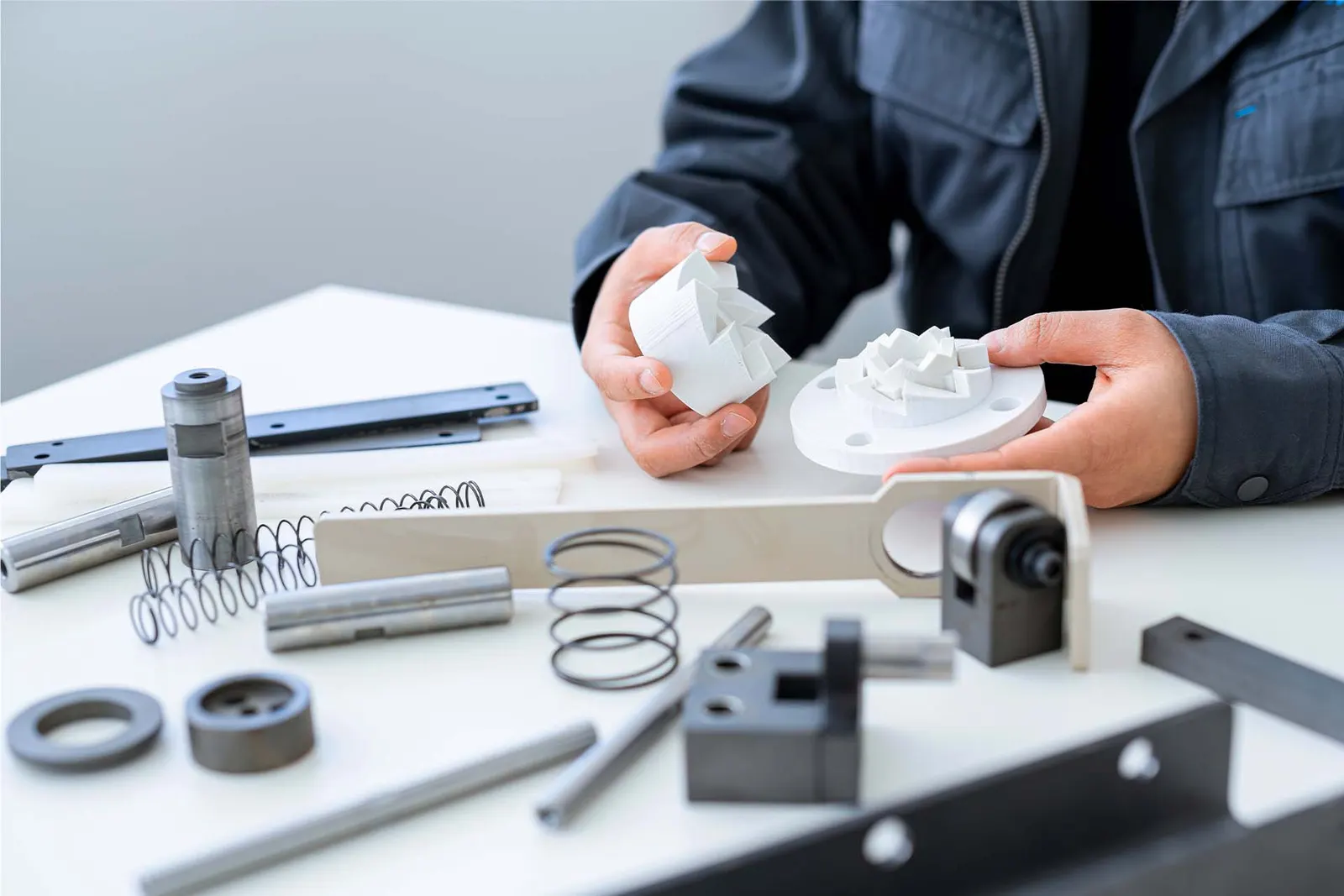
3D printing builds a part up layer by layer. CNC machining starts with a solid block and cuts material away. Both can make the same part, but one is usually cheaper, faster or more accurate for it. Since we do both, plus laser cutting and sheet metal, here is how we decide which route a part should take.
Choose 3D printing when
- The shape is complex. Internal channels, organic curves, lattices and parts that would need many machine setups are where printing shines.
- You need one, or a few. There is no tooling or fixturing, so a single part is economical.
- You are still changing the design. Print, test, adjust the CAD and print again, often within days. See rapid prototyping.
- Plastic is fine. PLA, PETG, ABS, TPU, resin and nylon cover most prototypes, enclosures and fixtures.
Choose CNC machining when
- It must be metal and the shape is simple. Blocks, plates, shafts and flanges are usually cheaper to machine from aluminium, steel or brass than to print.
- Tight tolerances matter. Bearing seats, precise bores and mating faces are machining’s strength.
- You need the full strength of solid material. Machined parts have no layers, so they behave the same in every direction.
- You need a smooth, machined finish on functional faces straight away.
Where metal 3D printing fits
For metal parts that are too complex to machine economically, such as internal cooling channels, lightweight lattices or several parts combined into one, we print in stainless steel 316L or aluminium by laser powder-bed fusion. Critical faces can then be machined for accuracy. It costs more than machining a simple part, so we only recommend it when the shape needs it. More on our metal 3D printing page.
And for flat parts: laser cutting and sheet metal
If the part is essentially flat, such as a panel, bracket, gasket or enclosure face, neither printing nor machining is the best answer. Laser cutting handles acrylic, wood and metal sheet quickly, and sheet metal fabrication adds bending, welding and powder coating for brackets, covers and chassis.
Quick comparison
| 3D printing | CNC machining | |
|---|---|---|
| Best for | Complex shapes, prototypes, plastic parts | Simple to moderate shapes in metal or engineering plastics |
| Quantity sweet spot | One-offs to a few hundred | One-offs to production runs |
| Accuracy | Good; critical features can be controlled | Excellent |
| Design changes | Very easy | Easy, may need new setups |
| Materials | Plastics, resin, nylon, steel and aluminium | Aluminium, steels, brass, Delrin, nylon |
A common path: print first, machine later
Many of our clients print a plastic prototype to check fit and feel, adjust the design, and then machine the final part in metal once it is right. Because CAD, printing and machining happen under one roof, the same model moves from one process to the next without starting over.
Not sure? Send the part
You don’t need to decide before asking. Send the file, a drawing or a photo on WhatsApp with the material, quantity and what the part does. We will tell you which process suits it and quote accordingly, usually the same day.
Questions people ask
Is CNC machining more expensive than 3D printing?
It depends on the shape. Simple metal parts are often cheaper to machine, while complex shapes and plastic prototypes are usually cheaper to print. We quote the route that suits the part.
Is a 3D printed part as strong as a machined one?
Plastic prints are strong for most prototypes and fixtures, but layers make them weaker in one direction. Machined metal is solid throughout. Metal 3D printed parts come close to machined strength.
Can you do both on the same project?
Yes. A common route is to print a prototype, refine the design, then machine the final part, using the same CAD model throughout.